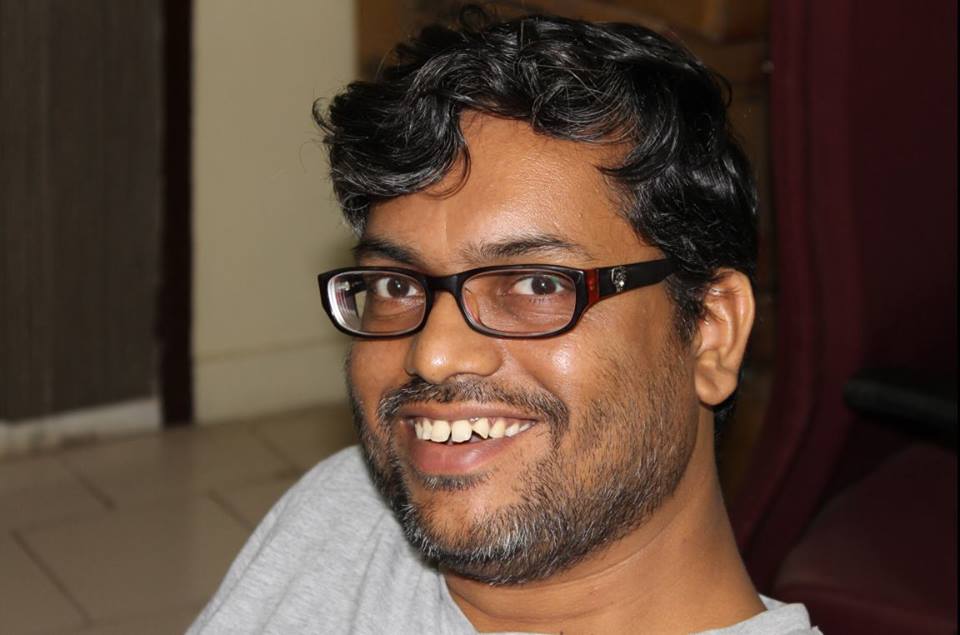
Dr Ananda Hota
#AnandaHota .signature
- UGC-faculty, UM-DAE Centre for Excellence in Basic Sciences (UM-DAE
CEBS) , India
-
Principal Investigator (PI), RAD@home Astronomy Collaboratory, India
-
Member, Consultative Group of the Principal Scientific Adviser to the Govt of India
-
Lead, Nationwide Inter-University Interdisciplinary Scientists for Society (NIISS) collaboration of 50 plus scientists in India
Mumbai , India
Research
Multi-wavelength (UV, optical, IR, radio) observational investigation of black hole-galaxy co-evolution in the Cosmic web. Special emphasis on Indian competitiveness like Giant Meterwave Radio telescope (GMRT) and citizen-science research using large population of science-educated Indians (Reference: RAD@home Astronomy Collaboratory, India, #RADathomeindia #ABCDresearch
Positions:
Faculty (Reader-F, UGC Asst. Prof.): UM-DAE Center for Excellence in Basic Sciences
December 2012 - Current
Visiting Astronomer: NCRA-TIFR, Pune
August-December 2012
Visiting Post-doc: IUCAA, Pune
June-August 2012
Post-doctoral Research Fellow: Academia Sinica Institute of Astronomy & Astrophysics (ASIAA), Taipei, Taiwan
March 2007 to March 2012
Visiting Fellow: Giant Meterwave Radio Telescope (NCRA-TIFR), Khodad, Pune, India
September 2006 - March 2007
Education
Ph.D. (Physics)
2006
Indian Institute of Science (Joint Astronomy Programme), Bangalore, India (2006) & National Centre for Radio Astrophysics - Tata Institute of Fundamental Research (NCRA-TIFR), Pune, India
M.Sc. (Physics)
1997
Sambalpur University, Odisha, India
B.Sc. (Physics Hons.)
1995
Sonepur College, Sambalpur University
Postal Address:
UM-DAE Centre for Excellence in Basic Sciences (UM-DAE CEBS)
(UM: University of Mumbai & DAE: Department of Atomic Energy, Govt. of India),
Vidyanagari, Kalina, Santacruz (E), Mumbai-400098, INDIA
Mobile: +91 - 98 69 123 321 CEBS Website: http://cbs.ac.in/people/physics-faculty/ananda-hota
Message
I was born and brought up in Sonepur (Subarnapur), western Odisha, India. Education: Adarsha UGME School (Estd. 1921), M R High School (Estd. 1913), Sonepur College (Estd. 1964). Sambalpur University (Estd. 1967). I got my Ph.D. (Physics (Astronomy & Astrophysics)) from Joint Astronomy Programme of the Indian Institute of Science (IISc; Bengaluru) & National Centre for Radio Astrophysics of the Tata Institute of Fundamental Research (NCRA-TIFR; Pune), India in 2007. After my 5 years postdoctoral research in Academia Sinica Institute of Astronomy and Astrophysics (ASIAA; Taiwan), I was invited to join UM-DAE Centre for Excellence in Basic Sciences (CEBS) in Dec 2012. I was promoted to Reader-F in August 2013 through an international expert review (for a Regular Faculty position) which has the approval from the Governing Council of UM-DAE CEBS.
Since June 2014, I am University Grant Commission (UGC) Assistant Professor in UM-DAE CEBS as CEBS authorities requested UGC to re-designate me and two others in UM-DAE CEBS as UGC-faculty. This UGC position is a Regular faculty position (till superannuation at 65 years) created by mission Faculty Recharge Programme of UGC-Ministry of Human Resource Development (now Dept of Higher Education, Ministry of Education, Govt of India). UGC provides me monthly-salary and start-up-grant which has partially helped establish my Nationwide Inter-University Citizen Science Research Startup named RAD@home Astronomy Collaboratory, India ( #RADatHomeIndia ), as presented in my UGC job interview and as per UGC FRP service condition. This was the prime reason for my return to India in 2012.
I have received the Best PhD Thesis award in the year 2007 from the Astronomical Society of India, the largest body of professional astronomers in India (now this is renamed as Justice Oak Award for Outstanding Thesis in Astronomy).
I am one of the three, who has been awarded "Samanta Chandrasekhar Jyotirbigyani Sanman" by SCAAA at IOP, Bhubaneswar, Odisha, India on 28th Feb 2018 Reference: https://goo.gl/PYjV97
Felicitated by Honorable Chief Minister, Govt of Odisha (Shri Naveen Patanaik) for my astronomical discoveries and my role as founding Director and Principal Investigator of RAD@home for citizen-science research with the GMRT, on 13th Dec 2017. Reference https://goo.gl/2gdC3e
For the same reason, especially for its impact on undergraduate education and research, I have been felicitated by the Director of Indian Institute for Science Education and Research (IISER, Kolkata), on 17th Aug 2019, and the Director and Registrar of IISER-Berhampur on 19th Oct. 2019.
Elected Member of The International Astronomical Union (IAU, Paris). IAU is the largest and oldest body of professional astronomers in the world. IAU Office of Astronomy for Education (Germany) and Shaw prize foundation invited me to speak on RAD@home in October 2021 along with citizen science representatives from NASA, Zooniverse, NAOJ (Japan) and CosmoQuest (USA). With IAU's financial supports RAD@home also presented its research results and conducted International workshop during IAU symposium-375 (December 2022).
I am an Associate member (independent) of the Square Kilometre Array (SKA) India Consortium (SKAIC), and international member of Extragalactic Continuum (galaxies/AGN, galaxy clusters) science working group. Square Kilometre Aray Observatory, head-quartered in UK, is an Billion-Dollar international observatory (radio telescope) with India as a partner country (Mega-project of India funded (Rs 1250 Crore) by the Govt of India (through DAE & DST). This will be the world’s largest radio telescope to explore the Universe. My research result on NGC3801 (NASA-JPL-CalTech news release 2012) was chosen to represent one of the 8 big science goals of SKA in the brochure and appeared in all SKA posters of multi-city Vigyan Samagam exhibition organised by DAE DST NCSM Govt of India (May 2019 to March 2020). My citizen science effort RAD@home appeared in the SKA website, SKA construction proposal for funding support from multiple governments. I lead the thinking about incorporation of citizen science research in astronomical research that can be undertaken with the SKA (see our publication here).
I was a Member of the Principal Scientific Adviser’s Consultative Group to advise the Govt of India on various matters of policy relating to science and society.
I am regular Reviewer/referee for Time Allocation Committees of Indian telescopes GMRT, ASTROSAT, DOT and for reputed international refereed journals MNRAS (IF 5.231), ApJ (IF 5.7), A&A (IF 6.209), Galaxies (IF 4.0), JOAA (IF 1.6).
I have been PI of successful research proposals in various international/national telescopes like GMRT, VLA, XMM-Newton, AstroSAT, SMA, ALMA, Subaru, CFHT, KISO, HCT, Lulin …
Research Publications: https://scholar.google.com/citations?user=paxEpRcAAAAJ&hl=en
h-index=15, Total citations= 880, Total Impact Factor: 100+
Discoveries led by me have made international news through Six International Press Releases (2011, 2012, 2013, 2022, 2025 and 2026)
*** International Press Releases and news on six of my Discoveries (Exotic galaxy Speca (2011), Cosmic Leaf-blower galaxy (2012), A blue supergiant star the farthest star (2013), RAD12 black hole jet hitting a galaxy (2022), Farthest and the most powerful Odd Radio Circle Discovery (2025), Bow-and-arrow radio galaxy (2026) and a national DST-Govt. of India press release on founding the first Indian citizen science research in astronomy RAD@home (2018). They are linked here
1. http://www.nasa.gov/centers/jpl/news/galex20120403.html
2. http://www.nsf.gov/news/news_summ.jsp?cntn_id=121556
4. http://www.time.com/time/health/article/0,8599,2111311,00.html
5. http://www.naoj.org/Pressrelease/2013/04/10/index.html
6. https://ras.ac.uk/news-and-press/news/black-hole-discovered-firing-jet-neighbouring-galaxy
7. https://ras.ac.uk/news-and-press/research-highlights/most-powerful-odd-radio-circle-date-discovered
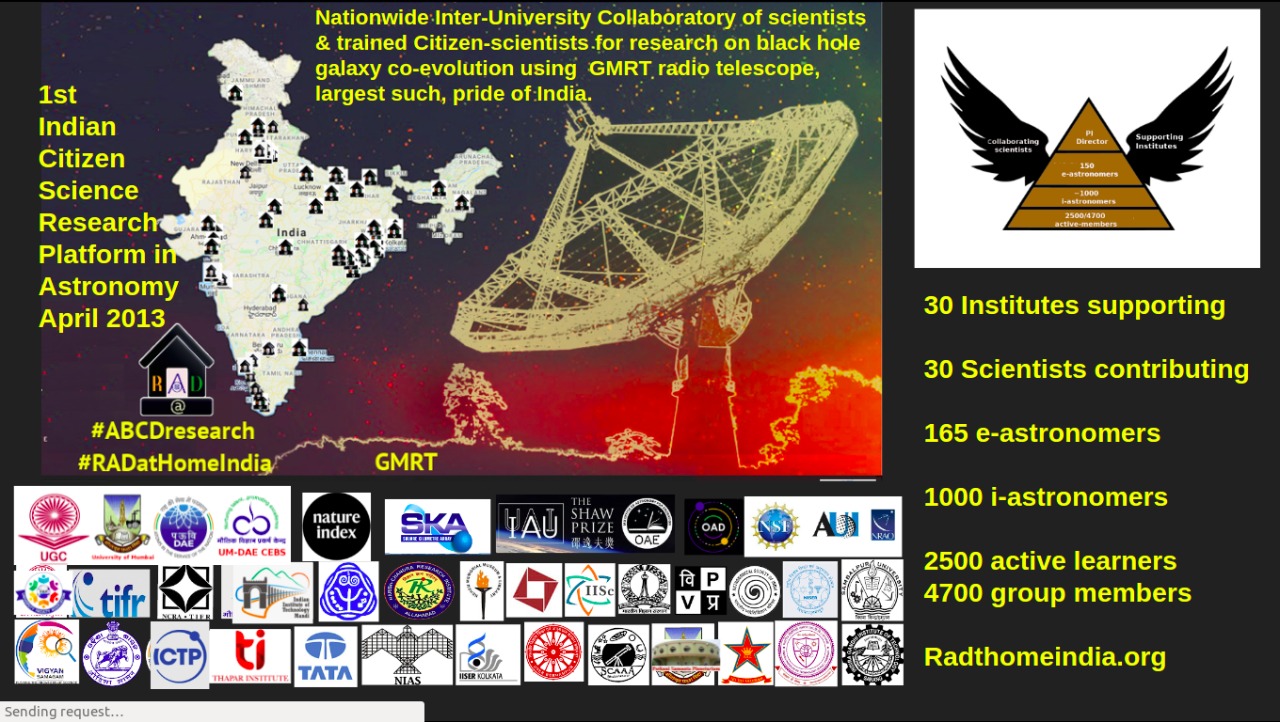
RAD@home, India (www.radathomeindia.org) launched on 15th April 2013 is not only the first but also the only Swadeshi/Indian Citizen-science Research platform in astronomy which uses data and observes from Indian telescopes to publish discoveries Internationally. It is a zero-funded zero-infrastructure nation-wide inter-university collaboratory of 200+ trained citizen-scientists or e-astronomers, dozen professional astronomers, and thousands of online-learners. Over thousand students/citizens have been trained on the basic multi-wavelength (UV-Optical-IR-radio) extra-galactic astronomy by RAD@home. We always welcome external cash/kind/moral support from any individual/institution, both Govt/Pvt, for our citizen-science research with the GMRT telescope, the largest such in the world, and pride of the nation. RAD has received institutional (infrastructural/financial) support from Vigyan Samagam (SKA-India Consortium, DAE, DST, NCSM, Govt of India), ICTS-TIFR, IOP, IISc, HRI, NISER, UM-DAE CEBS, Nehru Planetarium (Delhi), Vigyan Prasar (DST), IISER (Kolkata & Berhampur, Thiruvananthapuram), IIT (Delhi, BHU & Mandi), St. Stephens College (Delhi University), Thapar Institute, International Astronomical Union (IAU-OAD, OAE, & OAO), Dept of Science & Technology, Govt of Rajasthan, Govt of Odisha, Tata Steel, SCAAA, SKA-India Consortium, GTAC (GMRT/NCRA-TIFR), NIAS, University Faculty Association (India), etc. Office of the Principal Scientific Adviser to the Govt of India, of which I was also a member, promotes citizen science research. New Science, Technology & Innovation policy of the Department of Science and Technology, Govt of India also promote citizen science. Our Motto: Any BSc/BE Can Do research using GMRT sitting at home anywhere in India by joining RAD@home free of cost. #ABCDresearch #RADatHomeIndia #DilyGalaxyRGBC #DilSeDiscovery #NIUgalaxyRGBCanalysis
The research publications of RAD@home can be seen in the following page
https://www.radathomeindia.org/research
Press/News release from ISW, Vigyan Prasar, DST, Govt. of India on RAD@home is here http://vigyanprasar.gov.in/isw/inspired_bollywood_flick_power_facebook_indian_scientist_builds_army_e-astronomers_story.html
International Recognition to #RADatHomeIndia
Nature Index has chosen RAD@home, 1 of 3 globally, and highlighted in an article on citizen science research. The article is available here go.nature.com/2ZJraif This was also highlighted by the international SKA Observatory (UK) in their website and magazine Contact.
SKA: Square Kilometre Array (SKA telescope) international organisation (UK) have given public declarations for students/citizens to join RAD@home. This highlight appeared in their website and in the SKA magazine Contact. SKA listed RAD@home as one of the seven radio astronomy citizen science research programmes in the world. Refer https://www.skatelescope.org/outreachandeducation/outreach-resources/citizen-science/
IAU: International Astronomical Union (Paris, 100+ years old, largest body of professional astronomers in the world) has given public declarations for students/citizens to join RAD@home (especially so during the Covid-19 pandemic). IAU listed RAD as one of 20 astronomy programmes globally. IAU-OAD has supported one RAD workshop, and IAU-OAE has invited the PI to speak in their meetings. RAD proudly was one of the 5 selected astronomy citizen science programmes in the world along with Zooniverse, NASA citizen science programmes, NAOJ's Galaxy Cruize and CosmoQuest (USA). IAU has given grant support to enable RAD@home members present their research results and its model and co-organise the 1st international RAD@home Astronomy Workshop at the IAU Symposium 375.
Refer: RAD@IAU presentation and workshop certificate
https://astro4edu.org/shaw-iau/sessions/citizen-science/
https://www.iau.org/public/callforonlineresources/
The Brochure of RAD@home can be found here https://radathomeindia.org/brochure
Some of my other initiatives........
SARP@CEBS: https://www.facebook.com/SARPatCEBS/ http://goo.gl/VYLM2t
S3N3_India: https://www.facebook.com/S3N3.India/
QASTRO: . https://www.facebook.com/QastroSKAindia/
#eAstroLab: https://goo.gl/qMpSmP
NIISS: https://www.facebook.com/NIISScollaborationIndia
Selected Publications
- Link to the Google Scholar Profile https://scholar.google.com/citations?user=paxEpRcAAAAJ&hl=en
- RAD@ home discovery of a bow-and-arrow radio galaxy tracing a∼ 560 kpc bow-shock structure in a multihalo environment "Ananda Hota, Pratik Dabhade, Shubhrangshu Ghosh, Pranim Limbo, C Konar, Sagar Sethi, Souvik Manik, Aditya Sahasranshu, Sabyasachi Pal, Mitali Damle, Sravani Vaddi, Arundhati Purohit" https://academic.oup.com/mnras/article/549/4/stag1033/8711583 Press Releases: by RAS (UK), NCBJ (Poland), RAD@home (India)
- RAD@home discovery of extragalactic radio rings and odd radio circles: clues to their origins" Ananda Hota, Pratik Dabhade, Prasun Machado, Joydeep Das, Aarti Muley, Arundhati Purohit, MNRAS, https://academic.oup.com/mnras/article/543/2/1048/8267915 RAS Press Release: https://ras.ac.uk/news-and-press/research-highlights/most-powerful-odd-radio-circle-date-discovered RAD@home Press Release: https://radathomeindia.org/press-release-2025-most-powerful-odd-radio-circle-to-date-is-discovered
-
“RAD@home citizen science discovery of an active galactic nucleus spewing a large unipolar radio bubble on to its merging companion galaxy” https://academic.oup.com/mnrasl/article/517/1/L86/6755525 Press Release by RAS (UK), NCRA_TIFR, UM-DAE CEBS, RAD@home & media Coverage are here All the Title Links and Views
-
Tracking Galaxy Evolution Through Low-Frequency Radio Continuum Observations using SKA and Citizen-Science Research using Multi-Wavelength Data : Hota, Ananda; Konar, C.; Stalin, C. S.; Vaddi, Sravani; Mohanty, Pradeepta K.; Dabhade, Pratik; Dharmik Bhoga, Sai Arun; Rajoria, Megha; Sethi, Sagar http://adsabs.harvard.edu/abs/2016JApA...37...41H Associated Press release from ISW, VP, DST (Govt of India) is http://vigyanprasar.gov.in/isw/inspired_bollywood_flick_power_facebook_indian_scientist_builds_army_e-astronomers_story.html
-
Discovery of a spiral-host episodic radio galaxy : Hota, Ananda; Sirothia, S. K.; Ohyama, Youichi; Konar, C.; Kim, Suk; Rey, Soo-Chang; Saikia, D. J.; Croston, J. H.; Matsushita, Satoki ( http://adsabs.harvard.edu/abs/2011MNRAS.417L..36H) (Press-releases/news links: http://www.nsf.gov/news/news_summ.jsp?cntn_id=121556 http://www.ncra.tifr.res.in/ncra/for-public/gmrt-discovers-an-exotic-galaxy-revealing-tantalizing-tale http://www.ras.org.uk/news-and-press/217-news2011/2003-exotic-galaxy-reveals-tantalising-tale)
-
NGC 3801 caught in the act: a post-merger star-forming early-type galaxy with AGN-jet feedback Hota, Ananda; Rey, Soo-Chang; Kang, Yongbeom; Kim, Suk; Matsushita, Satoki; Chung, Jiwon ( http://adsabs.harvard.edu/abs/2012MNRAS.422L..38H) (Press-releases/News links: http://www.nasa.gov/mission_pages/galex/galex20120403.html http://content.time.com/time/health/article/0,8599,2111311,00.html http://www.nature.com/nindia/2012/120411/full/nindia.2012.49.html)
-
Discovery of a Possibly Single Blue Supergiant Star in the Intra-cluster Region of Virgo Cluster of Galaxies Ohyama, Youichi; Hota, Ananda ( http://adsabs.harvard.edu/abs/2013ApJ...767L..29O) (Press-release/News links:http://www.naoj.org/Pressrelease/2013/04/10/ http://en.wikipedia.org/wiki/SDSS_J1229+1122 http://timesofindia.indiatimes.com/city/mumbai/Mumbai-University-astronomer-spots-star-55-million-light-years-away/articleshow/19504295.cms)
-
Brochure of RAD@home and a short video presentation at Shaw-IAU-OAE meeting here
https://radathomeindia.org/brochure
https://www.youtube.com/watch?v=VMZzP4BPCsU