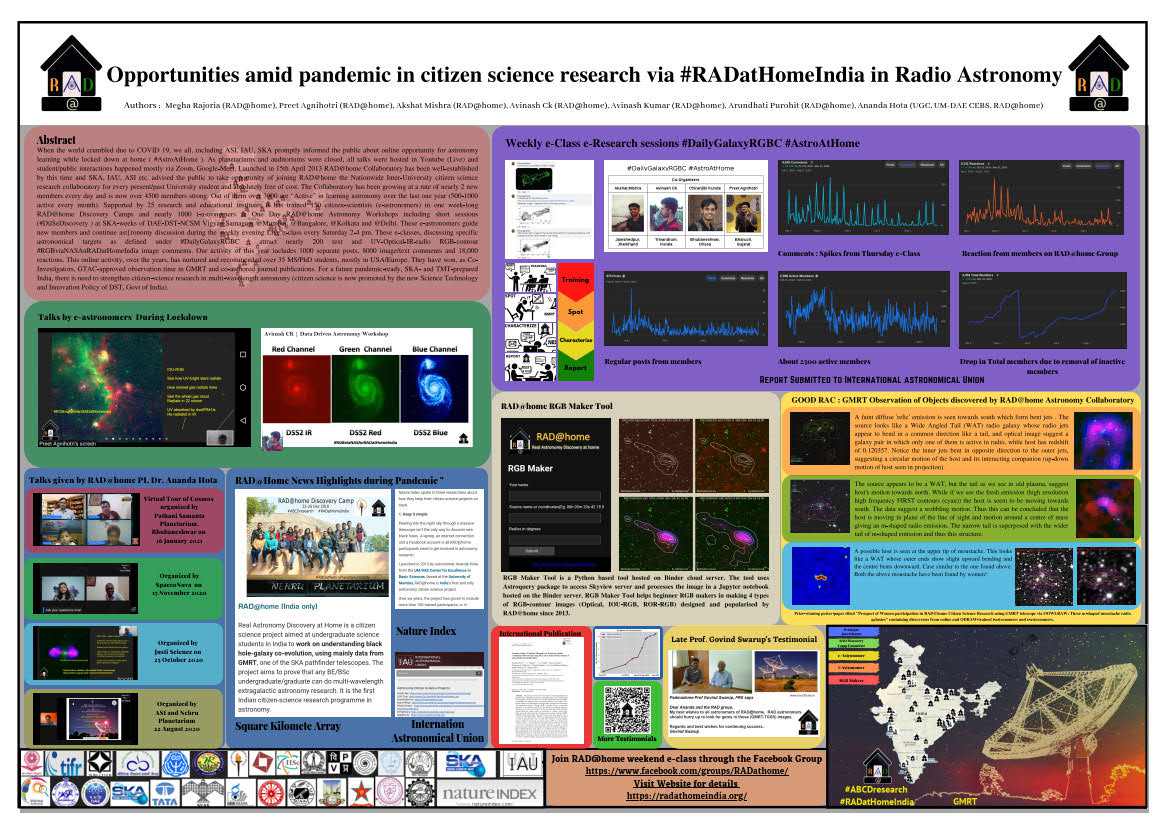
Mode of Presentation: Poster Authors and Co-Authors:
Megha Rajoria (1), Preet Agnihotri (1), Akshat Mishra (1), Avinash Ck (1), Avinash Kumar(1), Arundhati Purohit (1), Ananda Hota (1,2)
1. RAD@home Astronomy Collaboratory, India 2. UGC, UM-DAE Centre for Excellence in Basic Sciences (CEBS, Mumbai)
Abstract:
When the world crumbled due to COVID 19, we all, including Astronomical Society of India (ASI), International Astronomical Union(ASI), Square Kilometre Array (SKA) promptly informed the public about online opportunity for astronomy learning while locked down at home ( #AstroAtHome ). As planetariums and auditoriums were closed, all talks were hosted in Youtube (Live) and student/public interactions happened mostly via Zoom, Google-Meet. Launched in 15th April 2013 RAD@home Astronomy Collaboratory has been well-established by this time and SKA, IAU, ASI etc. advised the public to take opportunity of joining RAD@home the Nationwide Inter-University citizen science research collaboratory for every present/past University student and absolutely free of cost. The Collaboratory has been growing at a rate of nearly 2 new members every day and is now over 4500 members strong. Out of them over 2500 are “Active” in learning astronomy over the last one year (500-1000 active every month). Supported by 25 research and educational institutes it has trained 150 citizen-scientists (e-astronomers) in one week-long RAD@home Discovery Camps and nearly 1000 i-astronomers in One Day RAD@home Astronomy Workshops (ODRAW) including short sessions (#DilSeDiscovery ) at SKA-weeks of DAE-DST-NCSM Vigyan Samagam at Mumbai, Bangalore, Kolkata and Delhi. These e-astronomers guide new members and continue astronomy discussion during the weekly Live e-class every Saturday 2-4 pm. These e-classes, discussing specific astronomical targets as defined under #DailyGalaxyRGBC , attract nearly 200 text and UV-Optical-IR-radio RGB-contour #RGBviaNASAnRADatHomeIndia image comments. Our activity of this year includes 1000 separate posts, 8000 image/text comments and 18,000 reactions. This online activity, over the years, has nurtured and recommended over 35 students to pursue MS/PhD mostly in USA/Europe. They have won, as Co-Investigators, GMRT Time Allocation Committee (GTAC)-approved observation time in GMRT (through the ongoing project GOOD-RAC: GMRT Observation of Objects Discovered by RAD@home Astronomy Collaboratory) and co-authored international refereed journal publications. For a future pandemic-ready, SKA- and TMT-prepared India, there is need to strengthen citizen-science research in multi-wavelength astronomy (citizen science is now promoted by the new Science Technology and Innovation Policy of DST, Govt of India).